AI is increasingly being adopted across the hospitality industry. New tools are emerging for marketing, revenue management, guest services, reporting, and more. However, using AI for individual tasks does not necessarily translate into meaningful improvements in day-to-day operations.
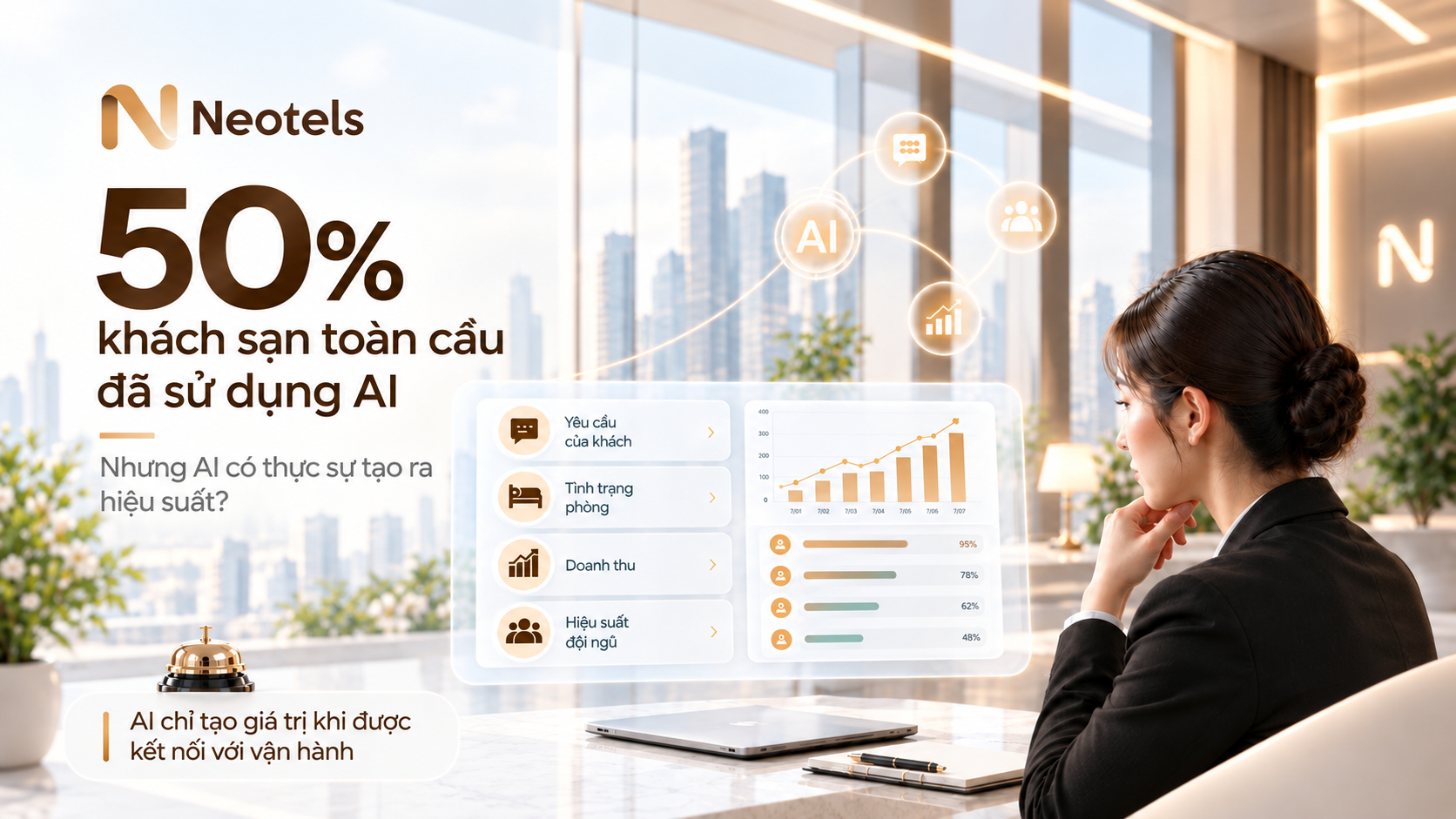
According to RateGain's State of Distribution 2026 report, more than 50% of surveyed hotels are using or implementing AI. At the same time, fewer than 10% reported that AI has helped reduce their manual workload by more than 30%. Research also shows that more than 80% of hotel commercial teams still spend 1–2 days each week creating and analyzing reports manually.
These figures point to an important gap: AI is already present in hotels, but its involvement in real-world operational workflows remains limited.
So, what should an AI system for hotels actually be able to do to create value in day-to-day operations?
What Is AI for Hotels?
AI for hotels refers to the use of artificial intelligence to support tasks related to guest communication, request management, and information processing throughout hotel operations.
One common application is an AI Concierge. Guests can ask questions, request services, or seek assistance without necessarily having to contact the front desk directly.
However, AI only becomes truly useful when the information shared by guests is connected to the hotel's operational workflows.
Why Do Many Hotels Use AI but Still Have Manual Work?
A chatbot can answer a guest's question, but providing an answer does not necessarily mean the guest's request has been handled.
For example, a guest may request two additional towels. AI can understand and respond to the request, but a hotel staff member still needs to receive the information and deliver the towels to the room.
If AI stops at the conversation stage, staff still need to check messages, forward requests to the relevant departments, and manually update the request status.
Therefore, the value of AI in hospitality lies in what happens behind the conversation.
What Tasks Can AI Support in Hotel Operations?
An AI system for hotels can participate in multiple steps of the guest service workflow:
Guest communication: support guests in multiple languages commonly spoken in Vietnam.
Request intake: capture requests for rooms, restaurants, services, or assistance during the guest's stay.
Request classification and routing: identify the relevant department and route the request to the right team.
Request tracking: allow managers to monitor request status through a Dashboard or Kanban.
Operational reporting: turn guest requests into structured data for monitoring and reporting.
The key point is that hotel staff still carry out the physical tasks. AI handles the intake, information processing, and routing that happen within the workflow.
How Is an AI Concierge Different from a Hotel Chatbot?
A hotel chatbot typically focuses on answering guest questions based on predefined or configured information.
An AI Concierge can participate more deeply in the service workflow. When a guest submits a request, the system can receive the request, identify what is needed, route it to the responsible department, and update its status for tracking.
This distinction matters when a hotel wants to integrate AI into its operations rather than simply add another communication channel.
What Is Neotels?
Neotels is an AI assistant for hotels, developed by Sphinx.
Neotels is built around the following workflow:
Guest submits a request → Neotels receives it → AI classifies it → Routes it → Hotel staff handles it → Management tracks the status
Guests can access Neotels via QR code without downloading an app. The system supports multilingual communication and receives guest requests throughout their stay.
For hotels, information does not remain isolated within individual conversations. Guest requests are converted into operational data that can be monitored through Dashboard and Kanban views, while also supporting SLA, KPI, and request-status tracking.
What Problems Does Neotels Solve for Hotel Operators?
For hotels with lean operational teams, particularly 3-star and mid-sized hotels, a significant amount of time can be spent on small but repetitive tasks throughout the day.
Neotels focuses on these operational challenges:
Reduce the workload of front-desk staff when receiving guest requests.
Support communication with international guests across multiple languages.
Reduce missed or misrouted requests by automatically routing them to the appropriate department.
Help managers track requests without having to check with individual staff members.
Centralize operational information in one system for easier monitoring and reporting.
Neotels can also be configured to connect with the systems and tools a hotel already uses, depending on its operational requirements.
Can 3-Star Hotels Use AI?
Yes. Hotels do not need to have a large-scale operation to adopt AI.
For 3-star hotels, the challenge often lies in staffing levels, daily request volumes, and the ability to keep track of multiple tasks throughout the day. A system that can receive and route guest requests can help staff focus more on tasks that require direct human involvement.
The key is to identify the right operational workflow to improve rather than implementing AI simply for the sake of adding another technology tool.
FAQ About AI for Hotels
Can AI for hotels replace hotel staff?
No. AI supports communication, request intake, classification, and information routing. Hotel staff still carry out tasks that require physical action and direct human involvement.
Is Neotels a hotel chatbot?
Neotels can communicate with guests, but it is designed to connect guest conversations with the operational workflow for receiving, routing, and tracking requests.
Do guests need to download an app to use Neotels?
No. Guests can scan a QR code to start using Neotels.
Is Neotels suitable for 3-star hotels?
Yes. The system can be configured according to the scale and operational workflows of each hotel.
Conclusion
AI for hotels does not necessarily have to start with large-scale or complex use cases. A specific workflow, such as receiving guest requests, routing them to the right department, and tracking their status, can already create a measurable improvement in day-to-day operations.
Neotels focuses on this workflow by bringing AI into guest service operations and request management.
Book a Neotels demo to explore how the platform can be implemented for your hotel.